Learning objects (LOs’) are important resources for instructors and educators. Digital learning objects (DLOs’) are reusable LO’s available in a (you guessed it) digital format.
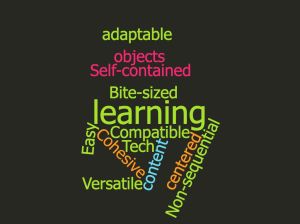
Good LO’s have the following qualities:
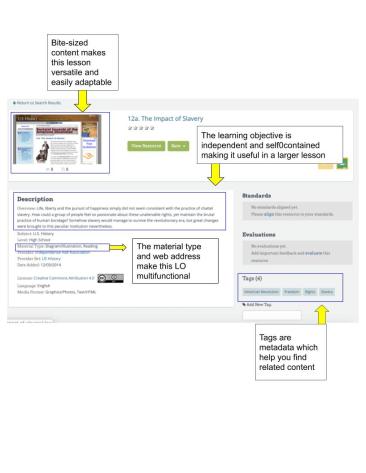
- Multi-functionality
- Self-contained independent learning objective
- Contains metadata
- Bite-sized learning content
- Non-sequential and sans-transition
To help build the necessary background knowledge I need to make sense of the LOs’, I explored interesting content by taking a deep dive into different Learning Object repositories to stimulate my curiosity and broaden my understanding of LOs’.
Most options for free LOs’ cater to K-12 and higher education instruction. However, OER commons contains general learning LOs’ and I am familiar with its resources from a previous course. In my exploration, I learned more about Open Educational Resources (OER). According to Green, Illowsky, Wiley, Ernst & Young (2018) OERs are teaching, learning, and research materials in any medium that reside in the public domain or that have been released under an open license that permits no-cost access, use, adaptation, and redistribution by others. OERCommons.org is a free digital library and collaboration platform that allows users to create OER’s, lesson plans, and courses. When users publishing content on OER, they make it available to other teachers and learners to use. They can collaborate, adapt, evaluate, and use the object based on their needs.
What interested me about OER the most was the Resource Builder feature that allows user to combine text, pictures, sounds, files, and video to make LOs’. LOs’ created with OER are printable and downloadable resources available as a PDF, as well as download all included media.
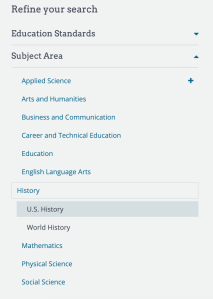
Using the search feature, I filtered for Career/Technical and Business and Communication. On the next page, I narrowed my search by Material Type “Case study” and “Management,” this search proved to be too narrow. Next, I revised my search to History, then U.S. history and found an OER for “The Impact of Slavery.”

This OER caught my attention because most learners can benefit from a general lesson about the impacts of slavery in the U.S.; it is something that still resonates within our society and American culture today.
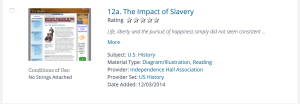
The LO I chose about the impact of slavery provided my insight that I have either previously forgotten or did not know. Two things that stuck out to me the most was, the definition of the Peculiar Institution and that the first Antislavery Society was founded by Quakers in 1775.
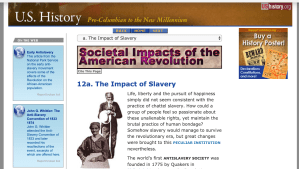
The LO I selected can by located on OER Commons by clicking here. This is a good example of a DLO because it is self-contained with an independent learning objective. This can be printed or hyper-linked for reading and/or as an illustration making it multi-functional. It is also a bite-sized, sans-transition, and non-sequential making it flexible enough to connect to other lessons for a larger lesson plan. The tags (metadata) allow users to search for other content related to it.
References:
Green, C., Illowsky, B., Wiley, D., Ernst, D., & Young, L. (2018, June 14). 7 Things You Should Know About Open Education: Content. Retrieved from https://library.educause.edu/resources/2018/6/7-things-you-should-know-about-open-education-content
 THE Inspired | Cynthia “Cyndy” Guillen, MBA, PMP, CSM